

Szia,
Tegnap Marco Polo kalandjaival foglalkoztunk, ma Darwinról olvashatsz és hallgathatsz meg egy szöveget!
Közeleg a karácsony, így már sokan elkezdték beszerezni az ajándékokat is. Én is hoztam neked most egy karácsonyi kuponkódot, amellyel 60% kedvezménnyel tudsz megvenni szinte minden videókurzust!

Nézd meg a tanfolyamokat, amikre érvényes ITT
Ha szeretnél átvenni velem élőben 14 ilyen szituációt (segítségkérés, véleménynyilvánítás, javaslattétel, bocsánatkérés, stb.), és megtanulni mindegyikre jó sok hasznos mondatot akkor januárban jön a 2026-év (valószínűleg egyetlen) ÉLŐ kurzusa, ha szeretnél velem tanulni 7 héten át, akkor erről bővebben ITT olvashatsz.
Ha pedig szeretnéd megszerezni az 5 Perc Angol Újrakezdőknek és Középhaladóknak utolsó megmaradt példányait (amelyet a LEVEL 2 tanfolyamon át is veszek veled videós formában kvízekkel, hangokkal, podcasttal), akkor most a könyv mellé megkapod a LEVEL 2 videókurzust is összesen 29,800 forint értékben, mindössze 9,900 forintos áron. Nézd meg ITT
… és térjünk is egy kicsit a felfedezőkhöz! A Lingea Kiadó csodálatos “Felfedezők” könyvei díszdobozban, képregényes formában dolgozzák fel (magyarul) négy híres felfedező kalandjait. Nézd csak! Én kaptam egy példányt ajándékba, és nem lehet letenni!

Most pedig jöjjön a mai lecke!
Üdv,
Nóri
MAI LECKE
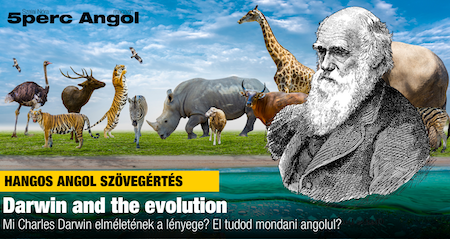
Charles Darwin
A HANGANYAGOT ÉS A SZÓSZEDETET ITT TALÁLOD
Charles Darwin was a pioneering thinker whose work in natural science changed how we understand the world. Born in 1809 in England, Darwin had a curious nature from a young age. He spent much of his time collecting insects and studying plants. His enthusiasm for the natural world grew further when he attended the University of Cambridge.
In 1831, Darwin joined a voyage on the HMS Beagle, which lasted almost five years. This opportunity allowed him to explore different parts of the globe, from the coasts of South America to the islands of the Pacific. During this journey, Darwin collected numerous specimens of plants, animals, and fossils. These diverse samples provided the foundation for his future theories.
One of Darwin’s most significant contributions is his theory of evolution by natural selection. In 1859, he published “On the Origin of Species,” where he argued that species evolve over time. His idea was that organisms best adapted to their environments are more likely to survive and reproduce. This process, which he called natural selection, leads to the gradual evolution of species.
At first, Darwin’s ideas faced skepticism and resistance from some religious and scientific communities. However, over time, his theories gained widespread acceptance and dramatically changed biology, providing a scientific explanation for the diversity of life on Earth. His work laid the groundwork for modern evolutionary biology.
Darwin’s achievements extended beyond his scientific theories. He inspired generations of scientists to pursue their own paths of discovery. His careful observations and willingness to question existing beliefs demonstrate the power of curiosity and critical thinking. Today, Charles Darwin is remembered as a key figure in the history of science, whose vision continues to influence our understanding of life.
