
1Monday, Again
My name is Anna Kovács. I am thirty-four years old, and I live in London. I come from Budapest, but I don't live there now. I live in a small flatflat [flæt]
lakás in North London, and I work in the city. I am an accountantaccountant [əˈkaʊntənt]
könyvelő.
Every morning, my alarm clockalarm clock [əˈlɑːm klɒk]
ébresztőóra rings at half past six. I hate it. I press the button, and I close my eyes again. Five more minutes. Then it rings again, and I get up.
I always do the same things. I take a shower. I make a cup of black coffee. I eat a piece of toast with butter and honey. That is my grandmother's habit, not mine, but I love it. I check my phone. I put on my grey suit. I have five grey suits. My best friend, Bella, says they are all the same suit. She is right.
At half past seven, I leave the flat and I walk to the station. The undergroundunderground [ˈʌndəɡraʊnd]
metró (Londonban) is always crowdedcrowded [ˈkraʊdɪd]
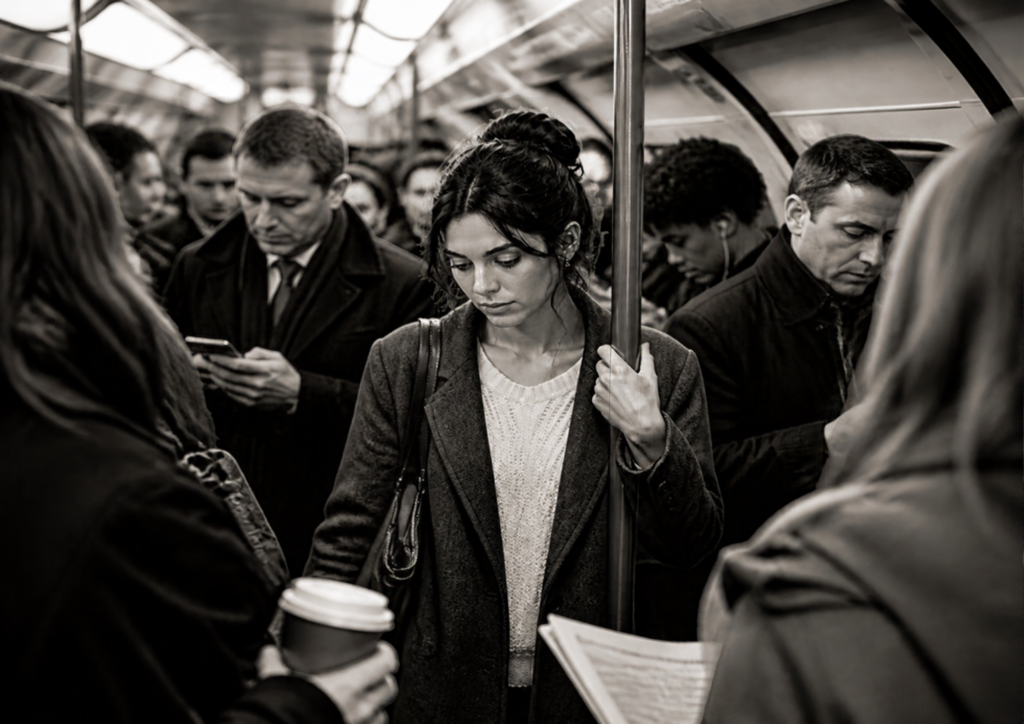
zsúfolt in the morning. People don't talk. They don't smile. They look at their phones, or they read, or they sleep standing up. I usually listen to music and look at the dark windows. I see my face in the glass. It looks tired.
My office is on the twelfth floor of a tall glass building. From my window I can see the river, the bridges and a lot of grey sky. I sit at the same desk every day. I work with numbers. I check other people's money. I make spreadsheetsspreadsheet [ˈspredʃiːt]
táblázat (pl. Excel). Lots and lots of spreadsheets.
"Is your job interesting?" people sometimes ask me.
"Yes," I say. "Very."
It isn't. It's boringboring [ˈbɔːrɪŋ]
unalmas. Really, really boring.
My bossboss [bɒs]
főnök is Mr Grant. He is about sixty, he has a red face, and he never says "please" or "thank you". He walks past my desk ten times a day. He doesn't stop. He just says, "Report, Anna. Friday." Every week, the same three words.
At lunchtime, most people go out to cafés and restaurants. I don't. I eat a sandwich at my desk and I answer emails. At six o'clock, I go home on the crowded underground again. I cook pasta for one. I watch a series on TV. I go to bed at eleven.
That's my life. Monday, Tuesday, Wednesday, Thursday, Friday. On Saturday I clean the flat, and on Sunday I call my grandmother in Budapest.
I know what you are thinking. Where is the love? Where is the romance?
Good question.
Mark is my fiancéfiancé [fiˈɒnseɪ]
vőlegény. No, sorry. Mark is my ex-fiancé. He lives in a beautiful house in South London with a yoga teacher called Sophie. They have a little white dog. They post photos of their perfect breakfasts online every morning. I don't look at the photos. Well, I don't look at them very often.
I still have the ringring; to ring [rɪŋ]
gyűrű; csörögni. It is in a box in a kitchen drawerdrawer [drɔː]
fiók, next to the batteries and some old keys. I don't know what to do with it.
So I live alone. Sometimes I feel lonelylonely [ˈləʊnli]
magányos, especially in the evenings. But I have Bella. Bella is my best friend. She works in a theatre, she has pink hair this month, and she calls me almost every day.
"You need a change, Anna," she always says. "A big change."
"I'm fine," I always answer.
I'm not fine. But I don't know that yet.
2The Letter
Today is Monday, the third of March. It is raining. Of course it is raining. This is London.
I am standing in the kitchen in my pyjamas. The coffee machine is making its usual noise. The radio is playing an old song. Outside, the rain is hitting the window, and a red bus is going past in the street.
Then I see it. There is a letter on the floor by the door.
I don't get many letters. Nobody writes letters these days. I get billsbill [bɪl]
számla (csekk) and pizza menus, and that's all. But this is different. It is a thick, cream-coloured envelopeenvelope [ˈenvələʊp]
boríték, and my name is on it in beautiful black letters: Miss Anna Kovács.
I pick it up. On the back, it says: Harris & Webb, Lawyers, Truro, Cornwall.
Cornwall? I don't know anybody in Cornwall. I know where it is: in the far south-west of England, by the sea. People go there on holiday. They eat ice cream, they surf, and they take photos of beaches. I never go on holiday.
My hands are shakingto shake [ʃeɪk]
remegni, rázni a little. Why? I don't know. I open the envelope and I read the letter. Then I read it again. And again.
Dear Miss Kovács,
We are writing to you about your great-auntgreat-aunt [ˌɡreɪt ˈɑːnt]
nagynéni (a nagyszülő testvére), Mrs Rose Kovács, of Gull Cove, Cornwall.
We are very sorry to tell you that Mrs Kovács is no longer with us.
In her willwill (noun) [wɪl]
végrendelet, Mrs Kovács leaves everything to you: her house, her shop (Rose's Books & Tea) and everything inside them.
Please contact our office. We need to see you in person.
Yours sincerely,
Edward Harris, Lawyerlawyer [ˈlɔɪə]
ügyvéd
I sit down at the kitchen table. My coffee is getting cold. The radio is still playing, but I'm not listening.
A great-aunt? Rose Kovács? I know the name. I think. My grandmother has a sister. Her name is Rózsa, which is "Rose" in English. But my grandmother never talks about her. Never. When I ask about her, my grandmother changes the subject. "Eat your soup, Anna."
And now this sister, this strangerstranger [ˈstreɪndʒə]
idegen (ember), gives me a house. And a shop. A bookshop!
I look at the clock. It's ten past seven. I'm late. Mr Grant is waiting. The spreadsheets are waiting.
I pick up my phone and I call my grandmother.
3A Phone Call to Budapest
My grandmother answers after two rings. She always answers after two rings.
"Anna? What's wrong? It's Monday."
My grandmother is eighty-three. She lives in a flat in Buda, near the river, and she knows everything about everybody. We speak Hungarian together, of course, but here is our conversation in English.
"Nothing is wrong, Nagymama. Well… maybe something. What are you doing?"
"I'm making soup. What are you doing? Why aren't you at work?"
"I'm sitting in my kitchen. I'm reading a letter. Nagymama… it's about Rózsa."
Silence. I can hear the radio in her kitchen. I can hear the soup. I can hear her breathingto breathe [briːð]
lélegezni.
"Nagymama? Are you there?"
"Yes." Her voice is very quiet. "I'm here. What does the letter say?"
I tell her. The house, the shop, the will. She doesn't say anything for a long time.
"Nagymama, who is she? Why don't you ever talk about her?"
"It's a long story, Anna."
"I have time." I don't, of course. Mr Grant is waiting. But I don't care.
"No. Not on the phone." She stops. Then she says something strange. She whispersto whisper [ˈwɪspə]
suttogni it, like a secretsecret [ˈsiːkrət]
titok.
"Be careful, my dear. Gull Cove is not a normal place. And Rózsa… Rózsa always has secrets."
"What do you mean? Nagymama?"
"My soup is boiling. I love you. Go to work."
And she puts the phone down.
I look at the phone in my hand. My grandmother never puts the phone down first. Never.
Something is very, very strange.
4A Big Decision
At work, I can't think about numbers. I'm looking at my spreadsheet, but I'm not seeing it. I'm seeing a little shop by the sea, with books in the window. I'm hearing my grandmother's voice. Be careful.
At eleven o'clock, Mr Grant stops at my desk. That's new. He never stops.
"Report, Anna. Friday."
"Mr Grant," I say. "I need some time offtime off [ˌtaɪm ˈɒf]
szabadság (munkából). One week."
He looks at me. His face is getting redder and redder. "A week? Now? Why?"
"Family," I say. "In Cornwall."
"You don't have family in Cornwall."
"I do now."
He opens his mouth. He closes it. He opens it again. He looks like a fish. "One week," he says at last. "And the report…"
"Friday. I know."
That evening, I call Bella and I tell her everything.
"A BOOKSHOP?" she shouts. I hold the phone away from my ear. "By the SEA? Anna, this is it! This is your big change!"
"It isn't a change, Bella. I just want to see the lawyer, sign the papers and sell the shop. That's all."
"Sell it? Are you crazy?"
"I'm an accountant. I don't know anything about books. Or tea. Or the sea."
"You read all the time. You drink tea all the time. And everybody knows about the sea. It's big, and it's wet."
I laugh. For the first time today, I laugh.
5On the Train
Now it is Wednesday morning, and I'm sitting on a train.
The train leaves London at ten past eight, and it arrives in Cornwall in the afternoon. The journeyjourney [ˈdʒɜːni]
utazás, út takes five hours. I have a book, a sandwich, a big coffee and my suitcasesuitcase [ˈsuːtkeɪs]
bőrönd, my small blue one. Everything is inside it: three sweaters, two pairs of jeans, my walking shoes and, yes, one grey suit. For the lawyer.
At first, the viewview [vjuː]
kilátás, látvány is grey: buildings, car parks, factories. But now it's changing. The city is slowly disappearing. Green fields are appearing, and little white houses, and sheep. Lots of sheep. The sun is coming out from behind the clouds.
My phone rings. It's Bella.
"Where are you? What are you doing? Tell me everything."
"I'm sitting on a train, Bella. That's all. I'm drinking coffee. I'm looking out of the window."
"What can you see?"
"Sheep."
"Very romantic. Any handsome men?"
I look around the carriagecarriage [ˈkærɪdʒ]
vasúti kocsi. There is a family with two small children. The children are eating crisps and fighting. An old woman is sleeping. A student is listening to music with big headphones. And there's a man oppositeopposite [ˈɒpəzɪt]
szemben me.
He's about forty. He has dark hair, an expensive coat and a newspaper. He is holding the newspaper, but he isn't reading it. I know this because the page never changes. He is looking at me. Every time I look up, he looks down quickly.
"Anna? Are you there?"
"Yes," I say quietly. "Bella, there's a man here. He's staringto stare [steə]
bámulni at me."
"Is he handsome?"
"Bella! I'm serious. It's strange."
"Maybe he likes you. You're beautiful, you know. Even in that grey suit."
"I'm not wearing the grey suit. I'm wearing jeans."
"Wow. This really is a big change."
I laugh, but I don't feel happy. I feel nervousnervous [ˈnɜːvəs]
ideges. When I look up again, the man is standing. He's taking his coat, and he's walking to the door at the end of the carriage. At the door, he stops. For one second, he turns round and looks at my suitcase. Then he leaves.
"Anna? Hello?"
"I'm here," I say. "It's nothing. Really. I'm tired, that's all."
But I keep my hand on my suitcase until the end of the journey.
6Gull Cove
At four o'clock, I change trains at a tiny station, and then I take a taxi. The taxi driver is a big man with a white beard. He doesn't talk much. He drives fast along narrownarrow [ˈnærəʊ]
keskeny country roads.
Then the road goes over a hill, and suddenly I can see the sea.
Oh.
It's enormousenormous [ɪˈnɔːməs]
hatalmas. It's blue and green and silver, and it's moving and shiningto shine [ʃaɪn]
ragyogni, világítani in the evening sun. Big white waveswave [weɪv]
hullám are breaking on the rocks below. On the left, there are tall, dark cliffscliff [klɪf]
szikla(fal), and on top of the highest cliff there is a white lighthouselighthouse [ˈlaɪthaʊs]
világítótorony. Seagullsseagull [ˈsiːɡʌl]
sirály are flying and crying above the water.
And there, in a little bay between the cliffs, is the village: Gull Cove. Small stone houses, white and pink and yellow and blue, are climbing up the hill. At the bottom of the hill, there is a harbourharbour [ˈhɑːbə]
kikötő with colourful fishing boats.
"Gull Cove," says the driver. It's his first word in thirty minutes. Then he looks at me in the mirror. "You're Rose's girl, aren't you?"
"I… sorry? How do you know?"
He shrugs. "Everybody knows. It's a villagevillage [ˈvɪlɪdʒ]
falu." He stops the car in a narrow street near the harbour. "Rose's Books & Tea. There you are."
7Mrs Penrose
The shop is an old stone building with a green door and a big window. Above the window, in gold letters, it says: Rose's Books & Tea. In the window, there are books: old books, new books, a pile of children's books and a sleeping orange cat.
I'm standing in the street with my suitcase and looking at the shop, when a door opens behind me.
"Hello, dear! You're Anna! Oh, you are! You look just like her!"
A small old woman is hurryingto hurry [ˈhʌri]
sietni towards me. She has white hair, bright pink lipstick and a yellow raincoat. She is carrying a plate with a cake on it.

"I'm Mrs Penrose. Margaret, but everybody calls me Mrs Penrose. I'm the neighbourneighbour [ˈneɪbə]
szomszéd. I live there, in the blue house. I come to the café every single morning for my tea and a scone. Every morning for twenty years! And this is lemon cake. I make it every Wednesday. Here, take it. You're thin. Too thin. Don't they feed you in London?"
"I… thank you, Mrs Penrose."
She doesn't stop talking. She tells me about the weather ("Terrible this year, terrible!"), the price of fish ("Too expensive!"), her son in Australia ("He never calls!") and the people in the village. The man at the pub drinks too much. The woman at the post office reads everybody's postcards. The vicar is in love with the woman at the bakery. Mrs Penrose loves gossipgossip; to gossip [ˈɡɒsɪp]
pletyka; pletykálni. I can see that.
"And Jack Trevelyan," she says, and she makes her voice very quiet. "Be careful of him, dear."
"Who is Jack Trevelyan?"
"The boat man. Down at the harbour. He builds boats, he fixes boats, he lives on a boat. He's handsome, oh yes, very handsome. But he doesn't talk to anybody. And he and Rose… well." She stops.
"Well what?"
"Nothing, dear. Nothing. Old village stories." She looks at the shop, and her eyes are wet. "It's a sad time here. Everybody missesto miss (somebody) [mɪs]
hiányolni (valakit) her. She's the heart of this village, you know." She takes a big old keykey [kiː]
kulcs out of her pocket and gives it to me. "Rose always leaves a key with me. Just in case."

"Thank you."
"And Biscuit, of course. You know about Biscuit?"
"Who's Biscuit?"
She points at the window. The orange cat is awake now. He is sitting up, and he is looking at me with big yellow eyes.
"He comes with the shop, dear," says Mrs Penrose. "He doesn't like people. He hates everybody. But look! He likes you!"
8The Shop
I open the green door. A little bell rings above my head.
Inside, it's dark and quiet. I find the light switch. And then I just stand there and look.
It's beautiful.
The shop is long and narrow, with old wooden floors. There are books everywhere: on tall shelvesshelf (pl. shelves) [ʃelf] ([ʃelvz])
polc from the floor to the ceilingceiling [ˈsiːlɪŋ]
mennyezet, plafon, in piles on the floor, on the chairs, even on the stairs. At the back, there is a little café: five small tables, old chairs of different colours, a wooden countercounter [ˈkaʊntə]
pult with a big teapot on it, and a fireplacefireplace [ˈfaɪəpleɪs]
kandalló. Everything is a bit dustydusty [ˈdʌsti]
poros, but it's warm and cosycosy [ˈkəʊzi]
otthonos, hangulatos. It smellsto smell (of) [smel]
illatot/szagot árasztani of old paper, coffee and something sweet. Cinnamon, maybe.
Biscuit jumps down from the window. He walks across the floor slowly, like a king. He sits in front of me and looks up.
"Hello, Biscuit," I say. "I'm Anna. I don't know anything about cats."
He walks round my legs, and he purrsto purr [pɜː]
dorombolni. Loudly.
"Okay," I say. "Okay. Maybe we can be friends."
I walk around the shop. I touch the books. Some are very old, with leather covers and gold letters. Some are new. There are books in English, French and German, and there is a whole shelf of books in Hungarian. Petőfi. Arany. Jókai. My grandmother's books. The books of my childhood.
On the counter, there is a photo in a silver frameframe [freɪm]
(kép)keret. Two girls are standing in front of a church in Budapest. They are about sixteen and eighteen. They are holding hands and laughing. The younger girl is my grandmother. I know her smile. The other girl has long dark hair and big dark eyes.
She looks like me. She looks exactly like me.
"Hello, Rose," I whisper.
9The Room Upstairs
The house is above the shop. I take my suitcase and I go upstairsupstairs [ˌʌpˈsteəz]
fel az emeletre; az emeleten. There is a small kitchen, a bathroom with an old bath, a living room full of books (of course!) and a bedroom. The bedroom window looks out over the harbour and the sea.
I open the window. The air is cold, fresh and saltysalty [ˈsɔːlti]
sós. Down in the harbour, the boats are moving slowly on the water. Their lights are coming on, one by one. On the cliff, the lighthouse is shining. Its light turns, and turns, and turns. Somewhere, a man is singing an old song.
Now I'm sitting on the bed with a cup of tea, and I'm eating Mrs Penrose's lemon cake. Biscuit is lying next to me. My phone is on the bed. There are three messages from Bella and one from Mr Grant: Report. Friday. I don't answer them.
I feel strange. I feel… happy? No. Not happy. Not exactly. I feel awakeawake [əˈweɪk]
ébren (van). That's it. For the first time in a very long time, I feel awake.
Maybe Bella is right, I think. Maybe I need a change.
Then I hear a noisenoise [nɔɪz]
zaj.
10Go Home
It's coming from downstairs. From the shop.
Biscuit hears it too. He sits up. His ears are moving. He's looking at the door.
I don't move. I'm listening. The wind is blowing outside. The sea is making its soft, sleepy sound. And then, there it is again. A quiet sound, like something knocking on glass. Tap. Tap. Tap.
"It's the wind," I tell Biscuit. "Just the wind."
Biscuit doesn't believe me. And I don't believe me either.
I get up. I take my phone and, for some reason, the big old key from Mrs Penrose. It's heavy. I hold it like a weaponweapon [ˈwepən]
fegyver. Then I walk down the stairs, very slowly. Every stair makes a noise. My heart is beatingto beat [biːt]
(szív) verni, dobogni fast.
The shop is dark. I don't turn on the light. Through the big window, I can see the street. The street lamp is making long shadowsshadow [ˈʃædəʊ]
árnyék on the wet stones.
And then I see it. Someone is standing outside the shop door. There is a dark shadow behind the glass. A tall shape. A person. They are putting something on the door. Tap. Tap. Tap.
Then the shadow moves. Somebody is running away down the street, towards the harbour. I can hear fast footstepsfootstep [ˈfʊtstep]
lépés (hangja) on the wet stones. Then nothing. Only the wind and the sea.
I'm scaredscared [skeəd]
megijedt, fél. My hands are shaking again. But I walk to the door, and I turn on the light on my phone.
There is a piece of paperpiece of paper [ˌpiːs əv ˈpeɪpə]
papírlap, cetli on the glass. The words are in big red letters, in ugly handwritinghandwriting [ˈhændraɪtɪŋ]
kézírás:
GO HOME, ANNA.
I read it again, and again, and again. In the dark shop behind me, Biscuit is growlingto growl [ɡraʊl]
morogni softly.
Somebody in Gull Cove knows my name.
And somebody in Gull Cove doesn't want me here.
~ End of Chapter 1 ~