
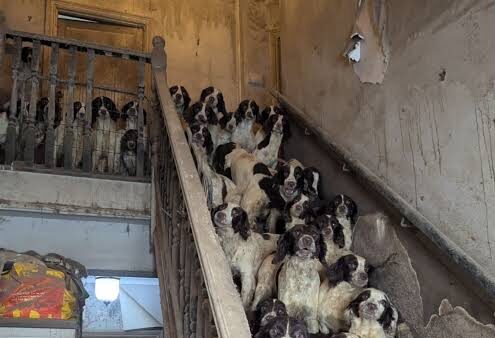
A man has been found guilty of animal welfare offences after more than 80 dogs were discovered living in filthy, overcrowded conditions at his family home in South Yorkshire, England.
David Parkes, 61, a children’s social worker, was convicted after a two-day trial at Barnsley Magistrates’ Court, which ended on 29 September. His wife, Delphine, and his son, Sam, had already admitted similar offences at an earlier hearing. All three will be sentenced at Doncaster Crown Court on 9 December.
The animals were rescued in April 2025 from a house in the village of Tickhill, near Doncaster. The RSPCA, Britain’s best-known animal welfare charity, became involved after a member of the public saw a dog hurt itself while jumping over a garden wall and reported it. Officers first visited the house on 5 April but were unable to speak to the family. Later, police and RSPCA officers entered the property together.
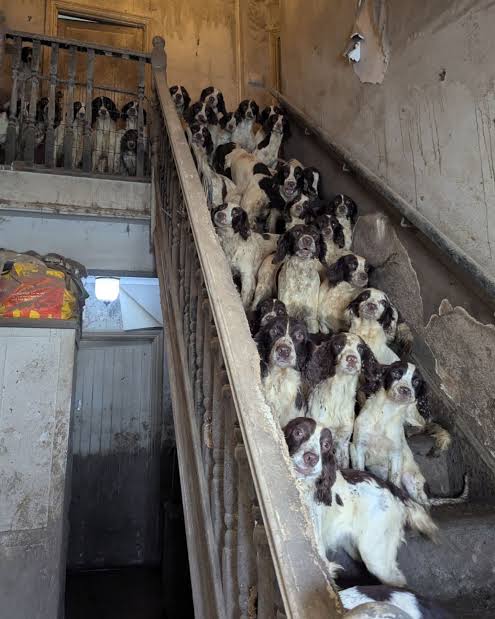
Inside, they found around 80 springer spaniel-type dogs, four Patterdale terriers – two adults and two puppies – and two cats. One inspector told the court that as soon as the kitchen door was opened, they were met by 20 to 25 spaniels, some hiding in the corners and others running around. More than 30 dogs were sitting on the stairs and the landing. The floors and stairs were covered in thick dirt and animal waste, and the smell was so strong that one RSPCA worker was sick. The officers said it was the worst case they had seen in their careers. Because the dogs had never been neutered, they had kept on breeding and their numbers had grown out of control.
Vets who examined the animals found that many had badly matted fur, were covered in dirt and were underweight. Five were critically thin, five had infected wounds and one had a very painful broken leg. The family had been using garlic to try to control fleas and other parasites.
Mr Parkes denied the charges, saying that he did not own the animals and was not responsible for them. However, the court heard that in an interview in April 2025 he had accepted that the family owned the dogs “to some capacity”. In court, he explained that he had been dealing with a very upsetting case at work at the time, and that his father had died in March 2025. He admitted that he should have made his home a priority. Mrs Parkes, for her part, had told inspectors that she knew they had too many dogs and that things had got out of control since the Covid-19 pandemic.
The family had to sign the animals over to the RSPCA. The charity says that all but one of them have now been rehomed. One dog had to be put down because of long-term health problems.

Write T (true), F (false) or NG (the text doesn’t say).
Choose the best answer: a, b or c.
What do these numbers refer to? Write a short answer.
Answers
True / False / Not Given:
F – he denied the charges.
T
F – a member of the public saw a dog hurt itself jumping over a garden wall.
T
T – around 80 were springer spaniel-type dogs.
NG
T
F – one dog had to be put down.
Multiple choice: 1b · 2a · 3b · 4c · 5b
Numbers:
David Parkes’ age
the number of spaniels in the kitchen when the door was opened
the number of dogs on the stairs and landing
dogs that were critically thin (also: dogs with infected wounds)
the date the family will be sentenced
the one dog that was not rehomed / was put down