1A Normal Day
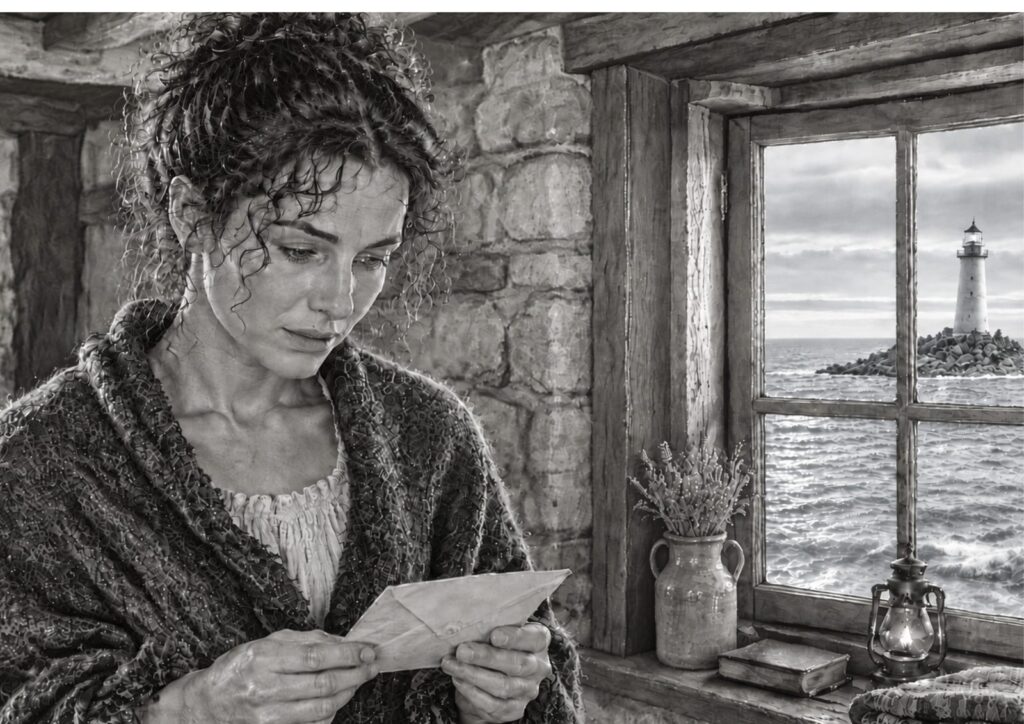
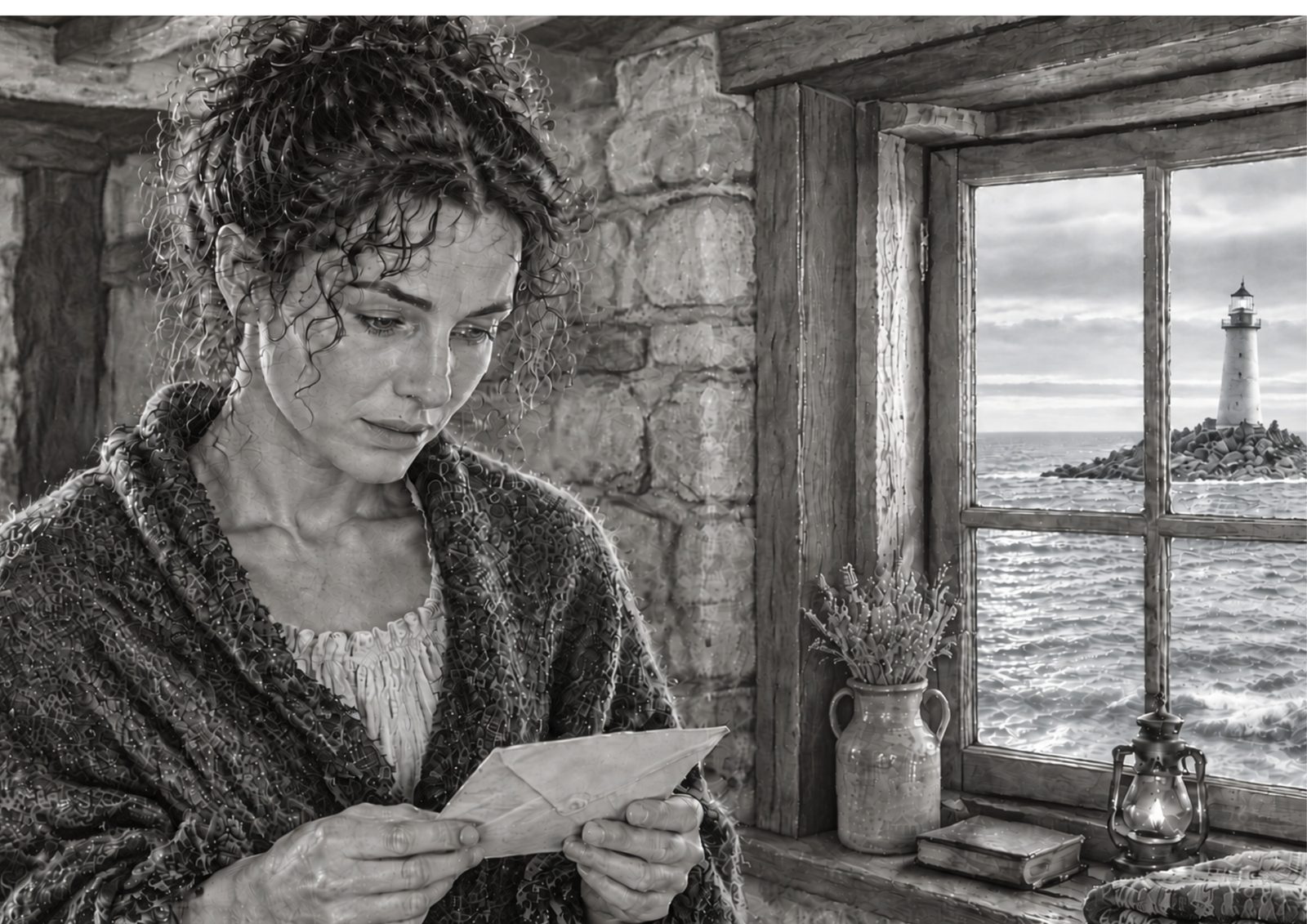
My name is Anna Trevelyan. Two weeks ago, my name was Anna Kovács. I am thirty-five years old, and I live in a lighthouse.
Well, not exactly in the lighthouse. I live in the little white cottagecottage [ˈkɒtɪdʒ]
kis ház, kunyhó next to it, on top of the cliff above Gull Cove, a small fishing village in Cornwall. From my kitchen window I can see the sea, the harbour and the roofs of the village. On a clear day, I can see the fishing boats far out on the water. On a foggy day, I can’t see my own hand.
I love it. Every day, I love it a little more.
My husband, Jack, gets up first. He always gets up at half past five. He doesn’t use an alarm clock. He says that the sea wakes him up. I don’t believe him, but it’s true that he is always awake before the birds. He makes a big potpot [pɒt]
kanna, fazék of strong tea, and he brings me a cup in bed. That is his promisepromise; to promise [ˈprɒmɪs]
ígéret; megígérni. “I can’t promise you an easy life,” he said on our wedding day, “but I can promise you tea in bed.” He is good at keeping promises.
At six, I get up and I go for a swim. Yes, in the sea. Yes, in Cornwall. The water is cold, even in July, and the first minute is terrible. But after that, it’s wonderful. My great-aunt Rose swam here every morning for sixty years. Now I do it too. I usually swim to the big black rock and back. The seagullsseagull [ˈsiːɡʌl]
sirály watch me and laugh. I think they are laughing at my swimming costumeswimming costume [ˈswɪmɪŋ ˌkɒstjuːm]
fürdőruha.
After my swim, I have breakfast with Jack in the kitchen. Toast with butter and honey, and more tea. Then he walks down to the lifeboat stationlifeboat station [ˈlaɪfbəʊt ˌsteɪʃn]
vízimentő-állomás, and I walk down the hill to my shop.
I have a shop. I still can’t believe it. A year ago, I was an accountantaccountant [əˈkaʊntənt]
könyvelő in London. I lived in a small grey flat, I wore grey suits, and I worked with numbers all day. Then a letter arrived from a lawyer, and everything changed. My great-aunt Rose left me her bookshop in Gull Cove: Rose’s Books & Tea. I came here for a weekend. I stayed for a year. And now I’m married to the lighthouse keeper.
It’s a long story. There is a shipwreckshipwreck [ˈʃɪprek]
hajótörés in it, and a lost treasure, and a cave, and a very bad man. Maybe you know it already. If you don’t, don’t worry. The most important things are simple: Rose was my grandmother’s sister. She came to England from Budapest in 1957, alone, with a small wooden box. The box had a broochbrooch [brəʊtʃ]
bross, kitűző in it, a gold rose with a red stone in the middle. Somebody stole the box. We found it. I wear the brooch now, on special days. And every evening at nine o’clock, my family thinks of each other. That’s our promise.
The shop opens at nine. I open the door, I turn on the coffee machine, and I feed Biscuit. Biscuit is Rose’s cat. Well, now he’s my cat. Or maybe I’m his person. He is big, orange and very lazy, and he sleeps in the shop window all day. The tourists take photos of him. He doesn’t care.
Then the customers come in. In summer, the village is full of tourists. They buy books about Cornwall, postcards and Rose’s famous lemon cake. A lot of them want to see the museum, too. Next to the shop, in the old fish marketfish market [ˈfɪʃ ˌmɑːkɪt]
halpiac, there is a small museum now: the Silver Gull Museum. It tells the true story of the shipwreck, and of Rose. I runto run (a business) [rʌn]
vezetni, működtetni (üzletet) it. I sell the tickets, I answer questions and I count the money. I’m still an accountant, really. I just count happier numbers now.
Every Wednesday, Mrs Penrose comes in at ten o’clock. She sits at the table by the window, she orders a cup of tea and a piece of lemon cake, and she tells me all the news from the village. Most of it is wrong. She is seventy-one, she knows everybody, and she loves gossipgossip [ˈɡɒsɪp]
pletyka more than lemon cake.
Sam doesn’t work in the shop any more. She studies computer science at a university in Bristol now. But she calls me every Sunday, and she often comes home at the weekend. And my best friend Bella still lives in London. She works in a theatre, and she calls me almost every day.
So that’s my life now. The sea, the shop, the museum, Jack, Biscuit. It’s not a spreadsheetspreadsheet [ˈspredʃiːt]
táblázat (számítógépes) any more. It’s a story.
But today, the story is changing.
2The Second Letter
It’s Wednesday morning, and it’s raining. Mrs Penrose is sitting at her table by the window. She is eating her lemon cake and she is telling me about Mr Harris’s new dog. I’m not listening. I’m reading a letter. Again.
This is the letter. It arrived three weeks ago, a week before our wedding. The envelope is old and yellowishyellowish [ˈjeləʊɪʃ]
sárgás, and the stampstamp [stæmp]
bélyeg is Hungarian. There is no name on the back. Inside, there is a single sheet of paper. The handwriting is small and neat.
Dear Ms Kovács,
I believe that you have something that belongs to my family. And I believe that I have something that belongs to yours.
That’s all. Two sentences. No name, no address, no phone number.
I read it every day. I know it by heart. I put it in a drawer, and I take it out again. I show it to Jack, and Jack reads it and says, “Hm.” Jack says “Hm” a lot.
“You’re not listening to me, dear,” says Mrs Penrose.
“Sorry, Mrs Penrose. What about Mr Harris’s dog?”
“Oh, never mind the dog. Is that the Hungarian letter again?” She leansto lean [liːn]
hajolni forward. Mrs Penrose knows about the letter, of course. Everybody in Gull Cove knows about the letter. Mrs Penrose tells everybody everything.
Then the door opens, and Ben the postmanpostman [ˈpəʊstmən]
postás comes in. He is wet, and he’s smiling.
“Morning, Anna. Another one for you. From abroad again.”
He puts an envelope on the countercounter [ˈkaʊntə]
pult. My heart starts to beat very fast. The envelope is old and yellowish. The stamp is Hungarian. And the handwriting is small and neat.
I open it with shaking fingers. Mrs Penrose stops eating. Ben stops smiling. Biscuit opens one eye.
Dear Mrs Trevelyan,
Congratulations on your wedding. I read about it in the newspaper. I am sorry about my first letter. It was very short. I am an old woman, and I am careful.
My name is Vera Szendrő. My father, Lajos Szendrő, worked in your great-great-grandfather’s workshop in Budapest in 1956. He was a young apprenticeapprentice [əˈprentɪs]
tanonc, inas there.
I have some old letters. They belong to your family. And I have some questions about the brooch.
I don’t talk about these things in letters or on the telephone. If you want answers, please come to Budapest. I am waiting for you.
Vera Szendrő
Under her name there is an address in Budapest and a telephone number.
I read it twice. Then I look up. Mrs Penrose’s mouth is open. There is lemon cake in it.
“Well?” she says. “Who is it from? What does she want? Is it about the treasure?”
“I don’t know, Mrs Penrose,” I say. And it’s true. I don’t know. But I’m going to find out.
3A Phone Call to Nagymama
That evening, I’m sitting at the kitchen table in the cottage. The rain is falling outside. The great lamp of the lighthouse is turning above our heads, and its light is moving slowly across the dark sea. Jack is standing at the stovestove [stəʊv]
tűzhely. He is cooking fish. He cooks fish every Wednesday. He says that a lighthouse keeper must eat fish.
“Call her,” he says, without turning round.
“Call who? Vera Szendrő?”
“No. Your grandmother.”
He’s right. He’s often right. It’s very annoying.
My grandmother, my Nagymama, is eighty-four years old. Usually she lives in a big old flat in Budapest, but at the moment she is staying with us in Gull Cove. She came for the wedding, and she didn’t want to go home. “I like the sea,” she says. “And I like your husband. And the cake in your shop is better than the cake in Budapest. Don’t tell anybody.” She is sleeping in our little spare roomspare room [ˌspeə ˈruːm]
vendégszoba, and she is going home to Budapest on Saturday.
Tonight she isn’t here. She is having dinner at Mrs Penrose’s house. They don’t speak the same language, but they talk for hours. I don’t know how.
I call her mobile. She answers after two rings, like always.
“Anna? What’s wrong? Why are you calling? I’m eating.”
“Nothing is wrong, Nagymama. I just have a question.” I speak Hungarian with her, always. “Do you know the name Szendrő? Lajos Szendrő?”
Silence.
I can hear Mrs Penrose in the background. She is laughing at something. I can hear plates and glasses. But my grandmother says nothing.
“Nagymama? Are you there?”
“Where do you hear this name?” Her voice is very quiet. It doesn’t sound like her voice.
“A woman is writing to me. From Budapest. Vera Szendrő. She says her father worked in your father’s workshop.”
Another silence. A long one.
“Nagymama?”
“Yes,” she says at last. “I know the name. Lajos was my father’s apprentice. He was a kind boy. I don’t know about his daughter.”
“She wants me to come to Budapest. She says she has some letters. Letters from our family.”
“What letters?”
“I don’t know. She doesn’t say.”
I hear her breathing. In. Out. In. Out.
“Anna,” she says. “Don’t go.”
“What? Why not?”
“Some things are better in the past. Leave them there.” And then she says something very strange. “It’s my fault. All of it. I don’t want to talk about it.”
And she hangs upto hang up [ˌhæŋ ˈʌp]
leteszi a telefont.
I sit and look at the phone. Jack puts two plates of fish on the table and sits down opposite me.
“Well?” he says.
“She says don’t go.”
“Hm,” says Jack. He looks at my face for a long time. “So when are we going?”
4Who Is Coming?
The next morning, my grandmother is sitting at the kitchen table when I come back from my swim. She is wearing her best coat, and she is holding her handbag on her laplap [læp]
öl (ülő emberé). Her eyes are red.
“I’m coming with you,” she says.
“Nagymama, you said…”
“I know what I said. I’m old. Old women change their minds. It’s allowed.” She looks out of the window at the sea. “It’s my city. It’s my family. And you don’t know anything about Budapest. You were twelve when you left.”
“I was twenty-four, Nagymama.”
“Exactly. A child.”
So she is coming. And Jack is coming too. “I don’t speak a word of Hungarian,” he says, “but I can carry the bags.” Pete, his friend from the lifeboat station, is going to look after Biscuit. Biscuit doesn’t like Pete. Pete doesn’t like Biscuit. They are going to have a wonderful time together.
I phone Vera Szendrő. A woman answers. Her voice is old, but strong.
“Szendrő.”
“Good morning, Mrs Szendrő. This is Anna Trevelyan. From Gull Cove.”
A short pause. “Good. You’re coming?”
“Yes. On Saturday. With my husband and my grandmother.”
Another pause. “Your grandmother. Ilona Kovács.” It isn’t a question. “Good. Come on Saturday evening. Seven o’clock. I make dinner.” And she hangs up too. People in my family don’t say goodbye on the phone. It’s a Hungarian thing, maybe.
Then I make a mistake. I tell Mrs Penrose.
She is in the shop at ten o’clock on Thursday. This is unusual. Mrs Penrose comes on Wednesdays, never on Thursdays. She is wearing a new hat.
“I hear that you’re going to Budapest, dear,” she says.
“Who told you that?”
“Oh, everybody knows.” She sits down at her table. “And I’m coming too.”
I nearly drop the coffee pot. “You’re what?”
“I’m coming with you. Your grandmother needs a friend. You and Jack are young, you’re always busy, you’re always kissing. Ilona needs somebody her own age.” She takes a passport out of her bag. It’s brand new. “I’m seventy-one years old, and I never go abroad. Never. Not once. My sister goes to Spain every summer and she sends me photos. Well, now I’m sending her photos.” She smiles. “Don’t worry. I’m paying for my own ticket.”
I look at Jack. He’s standing at the door, and he’s trying very hard not to laugh.
“Hm,” he says.
5In the Air
It’s Saturday afternoon, and I’m sitting on a plane. I’m sitting by the window. Below us, the clouds are white and thick, like a big soft bed. Somewhere under them, Europe is moving past.
I’m writing this in my notebook, because I’m too nervous to read.
Next to me, Jack is holding the arms of his seat. His face is white. My husband jumps into stormy seas to save people. He climbs the lighthouse in the middle of the night in winter stormsstorm [stɔːm]
vihar. But he hates flying.
“Are you OK?” I ask.
“I’m fine,” he says. He isn’t fine. “Boats floatto float [fləʊt]
úszni, lebegni (a víz felszínén). Planes don’t float. That’s all I’m saying.”
On the other side of the aisleaisle [aɪl]
folyosó (ülések között), my grandmother is sitting very straight in her seat. She is holding her handbag on her lap again, with both hands. She isn’t reading. She isn’t sleeping. She is looking at nothing.
And next to her, Mrs Penrose is having the best day of her life. She is wearing her new hat. She is talking to the flight attendantflight attendant [ˈflaɪt əˌtendənt]
légiutas-kísérő about lemon cake. Now she is showing her photos on her phone: the harbour, the lighthouse, Biscuit, Biscuit again, Biscuit in the shop window. The flight attendant is smiling politely. She is trying to give out the drinks.
“And this is Anna’s husband,” Mrs Penrose says, pointing at Jack. “He’s a hero, you know. He saves people from the sea. He’s not feeling very well at the moment.”
“I’m fine,” says Jack.
I’m wearing the brooch. It’s under my jumper, on the inside, so nobody can see it. I can feel it against my chestchest [tʃest]
mellkas. I don’t know why I’m wearing it. Vera asks questions about the brooch in her letter. Maybe I want to show it to her. Maybe I just want it near me.
I look at my grandmother again. She is moving her lips. She is saying something quietly, to herself. I can’t hear her, but I know the shape of the words. It’s a Hungarian prayerprayer [preə]
ima. She is praying.
I close my notebook. The plane is starting to go down. The seatbeltseatbelt [ˈsiːtbelt]
biztonsági öv sign is coming on. Jack is closing his eyes.
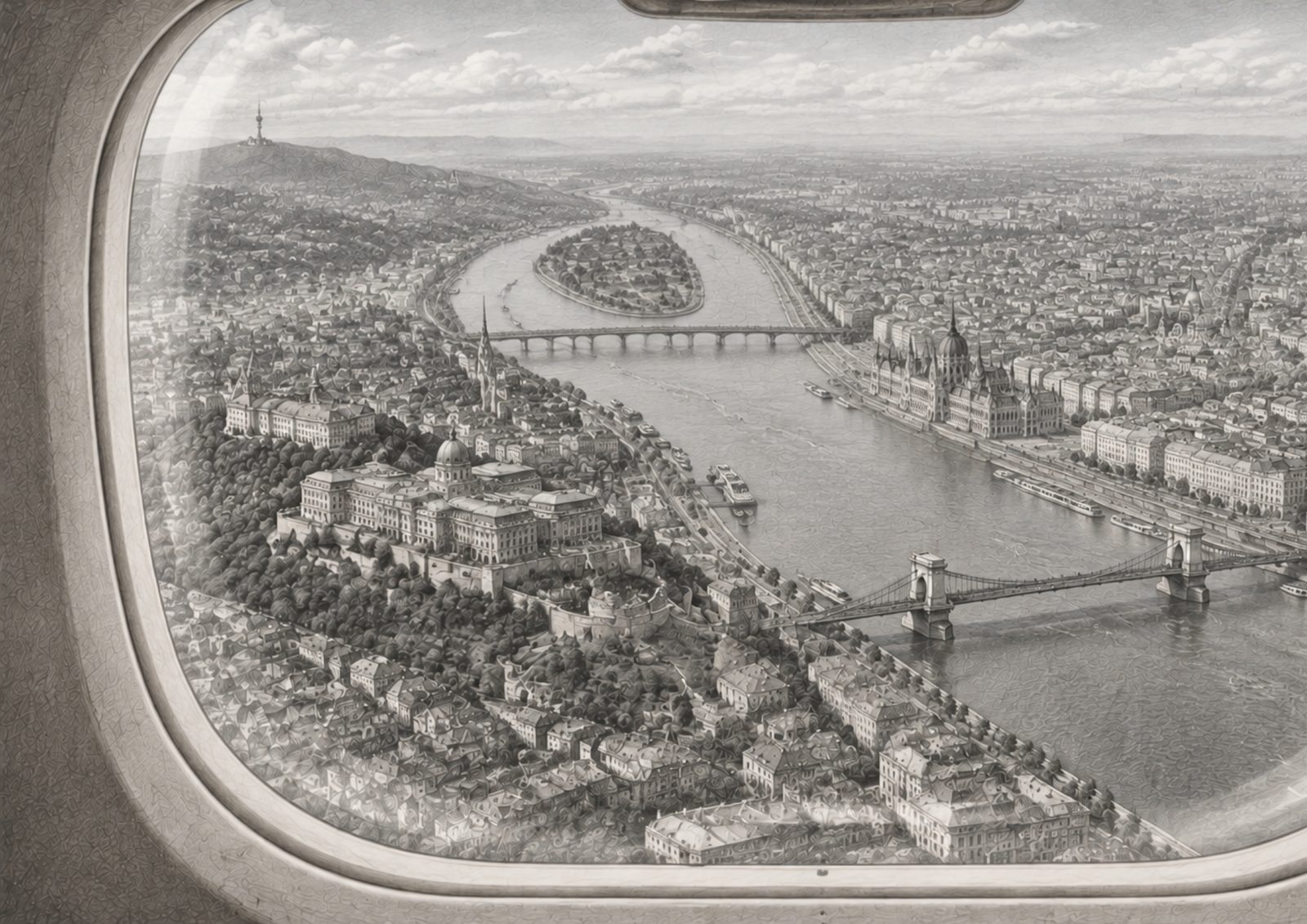
Through the window, the clouds are opening, and I can see green fields, small roads, a long grey river. The river is getting bigger and bigger.
“Is that the Danube?” Jack asks, with his eyes closed.
“Yes,” says my grandmother. It’s the first word she says in two hours. “That’s the Danube. We’re home.”
6Budapest
The taxi is driving into the city. It’s a hot evening, much hotter than Cornwall. Jack is sitting in the front, next to the driver. The driver is talking to him in Hungarian, very fast, about football. Jack is noddingto nod [nɒd]
bólintani and saying “Igen”, which means “yes”. It’s the only Hungarian word he knows. He says it to everything.
I’m sitting in the back between my grandmother and Mrs Penrose. I’m looking out of the window, and I’m trying to remember.
I was born in this city. I lived here until I was twenty-four. But it feels different now. The buildings are taller and more beautiful than I remember. There are new cafés everywhere, and new shops, and young people with bicycles. Trams are going past, yellow and noisy. And everywhere there is that sound of a big city in summer: cars, music, voices, a dog barking somewhere.
“Look, Mrs Penrose,” I say. “That’s the Parliament.”
We’re driving along the river now. On the other side of the water, the great ParliamentParliament [ˈpɑːləmənt]
Parlament, Országház building is standing in the evening sun, white and gold, with hundreds of windows. On our side, a long line of old chestnut treeschestnut tree [ˈtʃesnʌt ˌtriː]
gesztenyefa is moving past. People are walking along the river. A boat is moving slowly under a bridge.
Mrs Penrose is taking photos through the window. “Oh my goodness,” she keeps saying. “Oh my goodness. My sister is going to be so jealousjealous [ˈdʒeləs]
féltékeny, irigy.”
My grandmother says nothing. She is looking at the river. Her hands are holding her handbag very tightly.
We aren’t staying in a hotel. We’re staying at my grandmother’s flat. It’s in an old building in Pest, not far from the river, on the third floor. It’s a big flat with high ceilingsceiling [ˈsiːlɪŋ]
plafon, mennyezet, old furniture, and too many books. My grandmother lives here alone. My grandfather died twenty years ago. My mother lives in Canada now. So it’s just Nagymama, and the books, and the photographs on every wall.
I know this flat very well. I spent every summer here when I was a child. There is the same old liftlift [lɪft]
lift, small and slow, with a metal door. There is the same smell on the stairs: soup, dust and old wood. There is the same big brown door with the same three lockslock [lɒk]
zár.
“Home,” says my grandmother. She opens the three locks, one, two, three, and we go in.
Inside, it’s dark and hot. My grandmother walks through the rooms and opens the windows, one by one. The noise of the city comes in. Jack carries the bags in. Mrs Penrose is looking at the photographs on the walls and asking questions. “Who is this, Ilona? And who is this lovely man with the moustachemoustache [məˈstɑːʃ]
bajusz?”
And I’m standing in the hall, and I’m looking at an old photo in a frameframe [freɪm]
keret, képkeret. Two girls are standing in front of a church. One is about eighteen, with dark hair and a serious face. The other one is younger, about fourteen, and she’s laughing. Rózsa and Ilona, 1956.
I have the same photo in my shop in Gull Cove. Rose had one, and my grandmother has one. Two sisters, two photos, two countries.
It’s half past six. Vera Szendrő is waiting for us at seven.
“Nagymama,” I say. “Are you coming with us?”
She is standing at the window in the living room. She doesn’t turn round.
“No,” she says. “Not tonight. I’m tired. You go.” Then, very quietly: “Tell her… no. Don’t tell her anything. Just go.”
7A Note under the Door
It’s nearly midnight now, and I’m writing this in the kitchen of my grandmother’s flat.
Dinner with Vera Szendrő was… strange. I can’t describe it now. I’m too tired, and my head is too full. Tomorrow, maybe. I’m going to call Bella in the morning and tell her everything.
Everybody is sleeping. Mrs Penrose is in the little room at the end of the hall. She is snoringto snore [snɔː]
horkolni. I can hear her from the kitchen. Jack is sleeping on the old sofa in the living room, because the sofa is too short and the bed in the spare room is too soft, and he says he prefers the sofa. That’s not true. He’s being kind to me, because he knows I want to sit up and think.
My grandmother’s door is closed. There is no light under it.
The kitchen window is open. Outside, the city is still awake. A tram is going past in the street below. Some young people are laughing. Somewhere, a church clock is strikingto strike (of a clock) [straɪk]
ütni (óra) midnight. One, two, three…
I get up to make some tea. And then I hear it.
A small sound, in the hall. Very quiet. Like paper on a floor.
I stand still. My heart is beating fast. I listen. Nothing. Only the city, and Mrs Penrose’s snoring, and the church clock. …ten, eleven, twelve.
I walk slowly into the hall. I don’t turn on the light. The front door is in front of me, big and brown, with its three locks.
Something white is lying on the floor in front of the door. Somebody is pushing it under the door. Right now.
I can hear footstepsfootstep [ˈfʊtstep]
lépés (zaja) on the stairs outside. Somebody is going down. Fast.
I run to the door and I try to open it. One lock, two locks, three locks. My fingers are shaking. By the time I open the door, the stairs are empty. I look down. The old lift is standing still. The light on the stairs is going off. Somewhere below, the big front door of the building is closing with a bang.
I go back in, and I pick up the paper. It’s a small white card. On it there are three words, in big black letters, in Hungarian:
MENJ HAZA, ANNA.
I know these words. I know them in English too. Go home, Anna.
A year ago, somebody wrote exactly the same words on the door of Rose’s shop in Gull Cove.
I’m standing in the dark hall with the card in my hand. Behind me, a door opens. I turn round.
It’s my grandmother. She is standing in the door of her bedroom in her nightdressnightdress [ˈnaɪtdres]
hálóing, and she is looking at the card in my hand. She isn’t surprised. She looks afraid.
“So,” she says quietly. “It’s starting again.”
~ End of Chapter 1 ~